
A team at the University of Pennsylvania successfully induced stem cells to exhibit the properties and functions of a human adrenal gland, a development that may pave the way for new treatments for adrenal inadequacies.
The adrenal gland, located above the kidneys, is vital for maintaining overall health. It produces hormones that regulate essential functions such as blood pressure, metabolism, and fertility, in response to signals from the brain.
Individuals with adrenal gland disorders, such as primary adrenal insufficiency, where the gland does not produce enough hormones, can experience symptoms such as fatigue, low blood pressure, coma, and even death if left untreated. Currently, there is no cure for primary adrenal insufficiency and the hormone replacement therapy used to treat it has significant side effects.
A preferable alternative would be a regenerative medicine approach, regrowing a functional adrenal gland capable of synthesizing hormones and appropriately releasing them in tune with the brain’s feedback. With a new study in the journal Developmental Cell, researchers from the University of Pennsylvania School of Veterinary Medicine coaxed stem cells in a petri dish to divide, mature, and take on some of the functions of a human fetal adrenal gland, bringing that goal one step closer.
“This is a proof-of-principle that we can create a system grown in a dish that functions nearly identically to a human adrenal gland in the early stages of development,” says Kotaro Sasaki, senior author and an assistant professor at Penn Vet. “A platform like this could be used to better understand the genetics of adrenal insufficiency and even for drug screening to identify better therapies for people with these disorders.”
Creating Adrenal Tissue from Stem Cells
Sasaki says his team’s aim was to use human inducible pluripotent stem cells (iPSCs), which can give rise to a myriad of different cell types, to mimic the stages of normal human adrenal development. During this process, the cells would get directed to take on the characteristics of the adrenal gland.
To begin, the researchers used what’s known as an “organoid culture” system, in which cells grow first as a floating aggregate for three weeks, then on a membrane exposed to air on one side, promoting better survival and allowing them to proliferate in three dimensions. Utilizing a carefully selected growth medium, they prompted the iPSCs to elicit an intermediate tissue type in the adrenal development process, the posterior intermediate mesoderm (PIM).
After verifying they had cultured PIM-like cells, the researchers embarked on directing those cells to transition to the next stage, adrenocortical progenitor-like cells, during which cells turn on markers indicating they have “committed” to becoming adrenal gland cells.
Molecular assays to check for adrenal markers, as well as transmission electron microscope analyses, all told Sasaki and colleagues they were on the right track to recreating a tissue that resembled the early adrenal gland.
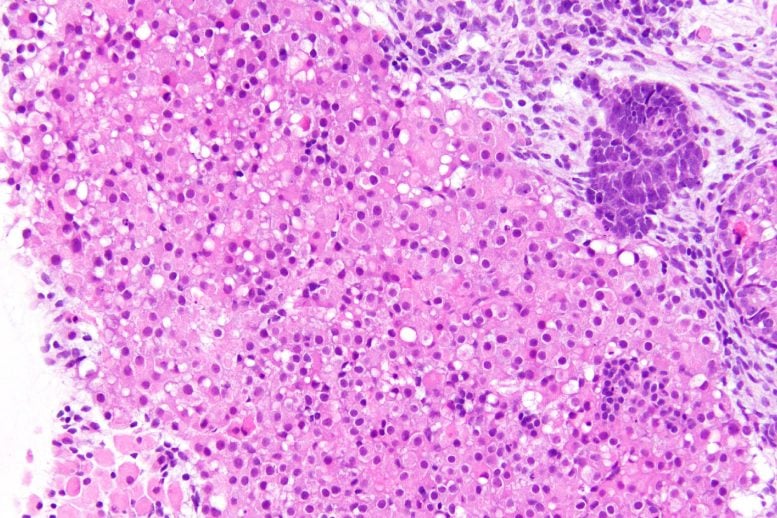
“The process we developed was highly efficient, with around 50% of cells in organoids acquiring adrenocortical cell fate,” says Michinori Mayama, a postdoc in Sasaki’s lab and a lead author on the study. “The ovoid cells with voluminous pink cytoplasm and relatively small nuclei that we saw in our cultures are very characteristic of human adrenal cells at that stage.”
Functionality Mirroring Natural Adrenal Glands
Sasaki, Mayama, and the rest of the research team performed a number of tests to evaluate how closely the functionality of the cells they had cultivated mirrored that of a human adrenal gland. They found that lab-grown cells produced steroid hormones, like DHEA, just as the “real-life” equivalent would. “In vitro, we can produce much of the same steroids that are produced in vivo,” Mayama says.
They also showed that the cells they grew could respond to what’s known as the hypothalamic-pituitary-adrenal axis, a feedback loop that governs communication from the brain to the adrenal gland and back again. “We used drugs that normally suppress adrenal DHEA production and showed that our iPSC-derived adrenal cells respond similarly to these drugs, with a marked reduction of hormone production,” says Sasaki. “This means that you can use this system for screening drugs that target adrenal hormone production, which could benefit patients with excessive adrenal hormone production or with a prostate cancer that exploits adrenal hormones for their growth.”
Potential Applications and Future Refinements
As the researchers refine their system, they say they hope to be able to generate more of the gradations in tissue type that occur in a mature adult adrenal gland.
Such a platform opens up opportunities to learn far more about the still-mysterious adrenal gland. In particular, Sasaki notes that it could be leveraged to probe the genetic basis of adrenal insufficiencies as well as other diseases, such as adrenal carcinomas. Ultimately, the approach used to create this gland-in-a-dish may one day work to reconstitute a functioning brain-adrenal gland feedback loop in people with adrenal gland disorders.
“This is a first-of-its-kind study,” says Sasaki. “The field of cell therapy holds so much promise for treating not just adrenal insufficiencies but other hormone-driven diseases: hypertension, Cushing syndrome, polycystic ovary syndrome, and more.”
Reference: “Reconstitution of human adrenocortical specification and steroidogenesis using induced pluripotent stem cells” by Yuka Sakata, Keren Cheng, Michinori Mayama, Yasunari Seita, Andrea J. Detlefsen, Clementina A. Mesaros, Trevor M. Penning, Kyosuke Shishikura, Wenli Yang, Richard J. Auchus, Jerome F. Strauss, and Kotaro Sasaki, 21 November 2022, Developmental Cell.
DOI: 10.1016/j.devcel.2022.10.010
The study was funded by the Silicon Valley Community Foundation and the Good Ventures Foundation.
Never miss a breakthrough: Join the SciTechDaily newsletter.
Follow us on Google and Google News.
1 Comment
But the real question is: Will it provide the same high as authentic adrenochrome? Inquiring Quidiots want to know!